- All
- Product Name
- Product Keyword
- Product Model
- Product Summary
- Product Description
- Multi Field Search
Views: 0 Author: Site Editor Publish Time: 2026-11-17 Origin: Site
Industrial environments subject electrical systems to severe mechanical stress, chemical exposure, and temperature extremes. Reliable cable routing acts as a baseline infrastructure requirement for any modern facility. Specifying inadequate conduit materials leads to premature jacket degradation, wire harness failures, unplanned maintenance downtime, and potential compliance violations. When cables remain exposed or poorly protected, the risk of catastrophic equipment failure increases exponentially. While various polymers and metals exist for cable management, Polypropylene (PP) has emerged as a high-performance standard across multiple sectors. This guide evaluates the technical advantages of PP corrugated conduit, compares it against PVC, PA, and flexible metal alternatives, and provides a framework for specifying the correct material for demanding industrial applications.
Superior Impact Resistance: PP corrugated conduit is up to 3 times more resistant to impact at low temperatures compared to traditional PVC (e.g., withstanding 6 joules at -5°C versus PVC's 2 joules), drastically reducing cracking risks in harsh environments.
Dynamic Flexibility: The corrugated geometry combined with PP's material properties provides high fatigue life and makes the conduit extremely easy to lay and shape as needed, making it ideal for robotics and moving machinery.
Chemical and Thermal Stability: PP resists a broad spectrum of industrial chemicals, oils, and solvents while maintaining structural integrity across wide temperature ranges.
Cost-to-Performance Ratio: Compared to premium Polyamide (PA) options or heavy flexible metal conduits, PP delivers comparable baseline protection for standard industrial wire harness protection at a significantly lower procurement and labor cost.
Industrial cable protection requires strict adherence to ingress protection ratings, crush resistance standards, and vibration dampening protocols. Without a robust physical barrier, sensitive communication cables and high-voltage power lines remain vulnerable to immediate physical damage. We must establish baseline success criteria before selecting materials for any facility upgrade or new build. Engineers evaluate conduit systems based on their ability to maintain a sealed pathway while absorbing external kinetic energy. The primary objective involves isolating the internal conductors from the external environment without restricting necessary movement or adding excessive bulk to the machinery.
Constant motion causes severe abrasion on unprotected wire jackets. Caustic fluids, including cutting oils, hydraulic lubricants, and industrial solvents, degrade standard insulation rapidly. Thermal cycling creates expansion and contraction stress that fractures brittle plastics over time. Effective industrial wire harness protection mitigates these risks by providing a sacrificial outer layer that absorbs environmental abuse. In automated manufacturing facilities, robotic arms perform thousands of repetitive cycles daily. If the routing pathway cannot handle this continuous flexing, the internal wires will eventually snap. This leads to costly production halts and complex repair procedures that drain maintenance budgets.
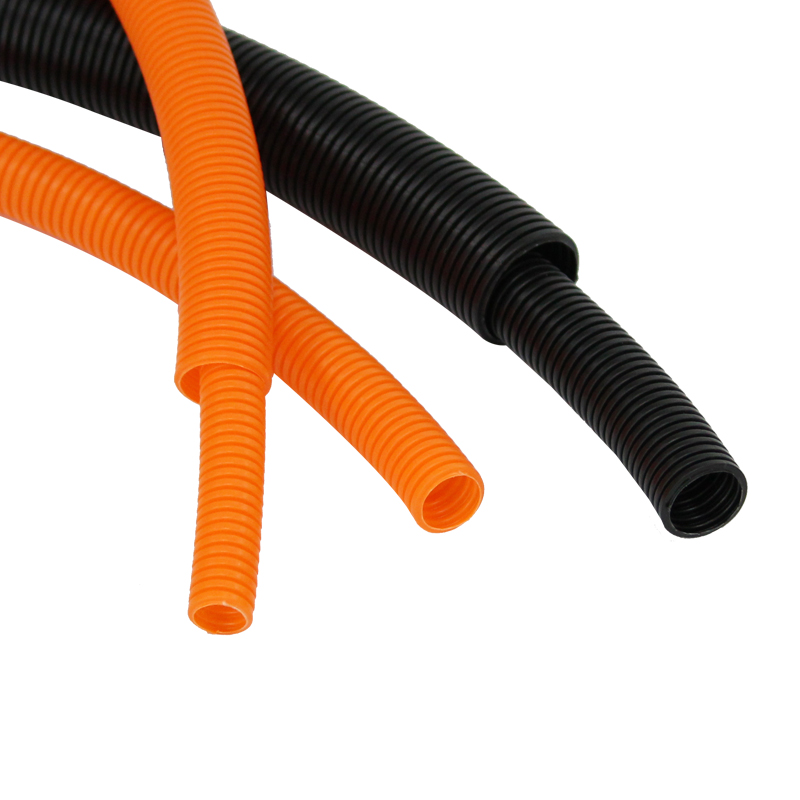
To understand why specific geometries work better than others, we look at the mechanical physics of the conduit profile. The alternating ridges and grooves of corrugated profiles distribute crush loads efficiently across the surface area. This structural design allows tight bend radii without kinking or collapsing the inner diameter. The geometry makes the flexible corrugated conduit extremely easy to lay and shape as needed. Technicians can route it around complex obstacles, through tight machinery housings, and along articulated joints without specialized bending tools. Unlike rigid tubing that requires heat bending or elbow fittings, the corrugated structure bends naturally while maintaining its internal clearance. This ensures wires are never pinched or compressed during installation.
We frequently observe three primary failure modes in unprotected or poorly protected industrial wiring setups:
Mechanical Abrasion: Continuous rubbing against machine frames or other cables wears through the primary insulation, exposing bare copper and creating short circuits.
Chemical Degradation: Exposure to synthetic coolants and degreasers causes standard polymer jackets to swell, soften, and eventually dissolve.
Impact Fractures: Dropped tools, forklift collisions, or shifting loads strike the wiring path, instantly severing conductors if the outer shield lacks sufficient impact resistance.
Polypropylene delivers exceptional durability at extreme temperatures. Empirical data demonstrates that PP corrugated conduit is three times more resistant to impact than PVC. It successfully resists up to 6 joules of impact energy at -5°C, whereas standard PVC fails at just 2 joules. This proves its superiority over brittle alternatives in cold storage facilities, winter construction sites, or unheated warehouses. When heavy tools drop or machinery collides with the conduit, PP absorbs the shock and rebounds. Inferior plastics shatter under similar conditions, exposing the live wires beneath and creating immediate safety hazards for floor personnel.
Beyond impact resistance, PP resists acids, alkalis, and inorganic salts commonly found in heavy industry. Dynamic applications demand high flexural fatigue life. Automated equipment and continuous-flex robotic arms rely on this durability to prevent premature material fatigue. Exposure to aggressive cleaning agents in food processing plants or chemical washdowns will not compromise the structural integrity of the conduit. The polymer matrix remains stable, preventing swelling, softening, or cracking even after prolonged chemical contact. This chemical inertness ensures the conduit maintains its IP rating over its entire operational lifespan, keeping internal wiring dry and secure.
The lightweight design of this plastic corrugated pipe simplifies installation on the job site. It reduces overall assembly weight, which matters greatly for moving machine parts where excess mass slows down cycle times and increases motor wear. Technicians experience significantly lower physical strain compared to handling heavier metal alternatives. Labor hours drop because the material cuts cleanly with standard hand tools and routes quickly through complex pathways. Faster installation directly translates to reduced project timelines and highly efficient maintenance turnarounds.
Enclosed industrial spaces, marine vessels, and mass transit applications require strict fire safety standards. PP offers distinct advantages due to its halogen-free composition. During combustion, it does not release toxic halogen gas. This characteristic protects personnel during evacuation and prevents sensitive electronic equipment from suffering corrosive smoke damage. Traditional PVC releases hydrogen chloride gas when burned. This gas forms hydrochloric acid upon contact with moisture, causing severe secondary damage to facility infrastructure long after the fire is extinguished.
Temperature tolerances differ vastly between PP and PVC. PP generally handles wider temperature extremes without deforming or losing its mechanical properties. Impact resistance over time strongly favors PP. We see the higher impact survival rate of PP at sub-zero temperatures as a major operational advantage for facilities operating in harsh climates. Environmental disposal also matters. PP is halogen-free and easier to recycle, aligning with modern environmental compliance standards. PVC disposal often requires specialized handling due to toxic byproducts generated during incineration.
Polyamide serves as the premium standard for extreme abrasion and ultra-high temperatures. However, we must evaluate the performance trade-off carefully. PP handles standard industrial demands perfectly at a fraction of the cost. You only need PA corrugated pipe when the application strictly requires extreme heat resistance, such as near engine blocks, foundry equipment, or industrial furnaces. Moisture absorption presents another critical factor. PA absorbs moisture from high-humidity environments, which can affect its dimensional stability and dielectric properties. PP remains highly moisture-resistant, maintaining its exact specifications regardless of ambient humidity levels.
Flexible Metal Conduit adds significant weight to any installation. PP is lighter and easier to cut or route, eliminating the need for heavy-duty hacksaws or specialized metal deburring tools. Corrosion resistance strongly favors polymers. PP is inherently immune to rust and oxidation. Flexible metal requires specific zinc coatings or thick liquid-tight polymer jackets in wet environments to prevent rapid degradation. Over time, metal conduits exposed to moisture and industrial chemicals will corrode. This corrosion compromises the grounding path and weakens the physical protection around the conductors.
Material Type | Operating Temperature Range | Cold Impact Resistance (-5°C) | Chemical & Moisture Resistance | Primary Industrial Application |
|---|---|---|---|---|
Polypropylene (PP) | -40°C to +105°C | Excellent (Survives 6 Joules) | High (Resists acids, alkalis, zero moisture absorption) | Standard industrial wiring, robotics, cold storage environments |
Polyvinyl Chloride (PVC) | -20°C to +80°C | Poor (Fails at 2 Joules) | Moderate (Vulnerable to certain solvents) | Light commercial buildings, static indoor routing |
Polyamide (PA) | -40°C to +120°C (Peaks higher) | Good | High (Resists oils, but absorbs ambient moisture) | High-heat zones, extreme abrasion environments, automotive engines |
Flexible Metal (FMC) | Varies heavily by jacket/coating | High (Prone to denting rather than shattering) | Low (Unless heavily jacketed, prone to rust) | Heavy mechanical crush zones, armored requirements, physical security |
Calculating the correct nominal diameter ensures proper cable fill and prevents overheating. Follow the National Electrical Code or local standards for maximum cable fill percentages. Typically, you should not exceed a 40% fill ratio for multiple conductors inside a single routing path. Standard availability ranges from AD 7.5mm to 34.5mm for standard harnesses. Manufacturers scale these dimensions up for heavy industrial mains and power distribution networks. Leaving adequate internal space allows for heat dissipation and makes future cable additions much easier without requiring a complete system teardown.
When specifying materials for a new build or retrofit, engineers must choose between slit and unslit profiles. Unslit configurations provide maximum ingress protection and structural integrity. They are the standard choice for new installations where wires can be pulled through the conduit before termination. Slit profiles work best for retrofitting, maintenance, and pre-terminated wire harnesses. You use slit versions when cables cannot be fed through end-to-end, such as when bulky connectors are already attached to the wire. The overlapping slit design still provides excellent mechanical protection while allowing technicians to wrap the conduit around existing cable bundles in seconds. This drastically reduces maintenance downtime on the factory floor.
Outdoor industrial applications require UV-modified polymers. Standard plastics degrade under continuous sunlight, becoming brittle and chalky over time. Specifying UV-stabilized custom PP corrugated tubing prevents photo-oxidation and material embrittlement over long-term exterior exposure. Manufacturers add specific carbon black or UV inhibitors during the extrusion process to block ultraviolet radiation. This ensures the corrugated conduit lasts for decades even in direct sunlight on rooftops, exterior machinery, or solar panel installations.
To ensure you source the correct material, follow these specification steps:
Measure the total outer diameter of the combined cable bundle.
Apply the 40% maximum fill rule to determine the minimum internal diameter required.
Identify the peak operating temperatures and lowest ambient temperatures in the installation zone.
Determine if the routing path is static (fixed to a wall) or dynamic (attached to a moving robotic arm).
Select the appropriate fittings and locknuts that match the IP rating required for the environment.
Never exceed the minimum static and dynamic bend radii specified by the manufacturer. Pushing past these limits causes the conduit to stress-craze, weakening the polymer structure and creating micro-fractures. Tight bends also restrict internal cable movement, leading to friction wear on the wire insulation as the machinery moves. Always calculate the required bend radius based on the thickest cable inside the bundle. Ensure the conduit routing pathway accommodates sweeping curves rather than sharp angles. When pulling wire through these curves, use appropriate pulling lubricants that do not degrade the polypropylene material.
Use compatible, IP-rated fittings, locknuts, and mounting clips to secure the system. System failure often occurs at the interface between the conduit and the enclosure. A compromised seal allows moisture, dust, and cutting fluids to enter the electrical panel, leading to short circuits. Ensure that all termination points utilize proper O-rings and strain relief mechanisms. Relying on incompatible fittings or standard zip ties to secure the conduit creates weak points. These weak points will inevitably fail under heavy vibration or mechanical pulling.
Long conduit runs experience linear thermal expansion and contraction as ambient temperatures fluctuate. Account for this coefficient during installation. Proper spacing and expansion joints prevent buckling or tension at termination points. If you secure a long run of PP conduit too tightly without allowing for thermal movement, the material will warp, bow, or pull out of its fittings during extreme heat. Use sliding mounting clips that hold the conduit securely while allowing it to glide back and forth as it expands and contracts naturally along the wall or unistrut frame.
PP corrugated conduit stands as a highly effective solution for modern cable management. It offers superior durability and cold-weather impact resistance compared to PVC. It provides better efficiency than PA and easier installation than metal conduits for most standard industrial applications. By balancing mechanical strength, chemical resistance, and installation speed, PP delivers a highly reliable protective barrier for wiring infrastructure.
The specific operating environment must drive the final specification. Always evaluate temperature peaks, chemical types, and dynamic versus static routing requirements before making a selection. Do not over-specify expensive materials when PP meets all technical requirements, but do not compromise on protection in environments that demand specialized polymers for extreme heat or heavy crush zones.
To optimize your facility's cable management strategy, execute the following next steps:
Audit your current wire protection systems to identify areas with high failure rates or visible jacket degradation.
Calculate the required fill ratios for your most critical cable bundles to ensure existing conduits are not overfilled and overheating.
Consult with manufacturers to request material samples of UV-stabilized or custom-slit PP profiles for application-specific testing.
Standardize your procurement list to include compatible IP-rated fittings and sliding mounting clips for all new conduit installations.
A: PA (Polyamide) offers higher temperature and abrasion resistance, making it ideal for extreme environments like engine compartments. PP (Polypropylene) provides superior moisture resistance, zero water absorption, and a lower procurement cost while handling standard industrial stresses effectively.
A: PP is significantly lighter, inherently immune to rust, and much easier to cut and shape on the job site. FMC is heavier and rigid, often requiring specialized cutting tools and anti-corrosion coatings for wet environments.
A: Yes, but you must specify UV-stabilized black PP variants. Standard PP degrades under prolonged sunlight, so manufacturers add UV inhibitors to prevent photo-oxidation and embrittlement in outdoor applications like solar arrays or rooftop wiring.
A: Standard flexible corrugated conduit lacks the crush resistance required for direct burial. You must use specific heavy-wall variants or alternative rigid conduits designed to withstand soil weight, ground shifting, and heavy surface traffic.
A: Use specialized rotary conduit cutters that score the outer ridges without penetrating deeply into the core. For retrofitting over existing live wires, use pre-slit conduit configurations to avoid cutting near the cables entirely.
A: Halogen-free means the material contains no chlorine, fluorine, or bromine. In a fire scenario, it will not release toxic, corrosive smoke, protecting both personnel during evacuation and sensitive electronic equipment from secondary acid damage.
A: Measure the total cable bundle diameter and factor in required clearance for heat dissipation. Follow standard fill ratio guidelines, typically keeping the fill under 40%. Common sizing ranges from 7.5mm to 34.5mm and above.