- All
- Product Name
- Product Keyword
- Product Model
- Product Summary
- Product Description
- Multi Field Search
Views: 0 Author: Site Editor Publish Time: 2026-07-12 Origin: Site
Extreme thermal environments pose incredibly high stakes for industrial cable systems. Cable failure triggers catastrophic downtime across busy production facilities. It creates severe safety hazards for plant operators almost immediately. It also destroys highly sensitive and expensive electrical equipment. You must protect these vital lifelines reliably. Standard insulation materials often fail completely in these harsh conditions. Why does this physical failure happen? Standard plastics simply absorb ambient heat rapidly. They also aggressively absorb intense radiant heat. Radiant energy acts completely differently from basic ambient warmth. It travels directly through the air as invisible infrared waves. It quickly bakes any exposed surface it touches. You need a highly specialized shield.
This technical evaluation guide helps engineers make informed material choices. It directly assists procurement managers in specifying critical protective barriers. You will learn how aluminum foil glass sleeving protects vulnerable infrastructure effectively. We explore fundamental material architecture, precise sizing rules, and installation practices. By the end, you will confidently evaluate this protective barrier for your toughest applications.
Engineers face difficult decisions when routing cables near intense heat sources. Specifying the wrong material leads to rapid system degradation. Selecting the right barrier extends component life significantly. Industrial applications require precise thermal shielding strategies. Over-specifying burns through engineering budgets unnecessarily. Under-specifying invites unexpected and catastrophic system failures. Both errors harm daily operational efficiency.
Let us break down radiant versus convective heat. Convective heat involves warm air circulating around physical components. Standard rubber conduits handle basic convective heat adequately. However, radiant heat changes the entire physics equation. Radiant energy radiates outward from a primary glowing heat source. Standard plastic completely absorbs this incoming radiant energy. The internal temperature of the conduit spikes rapidly. Eventually, the internal cable jacket melts away entirely.
In stark contrast, high-temp aluminum foil sleeving reflects this energy. It physically bounces infrared waves away before penetration occurs. The jacket remains safely cool underneath. We see this strict necessity in highly specific target applications. Identifying these primary use cases proves essential for system safety.
These harsh environments demand reliable radiant reflection immediately. Traditional ambient insulation remains strictly non-negotiable here.
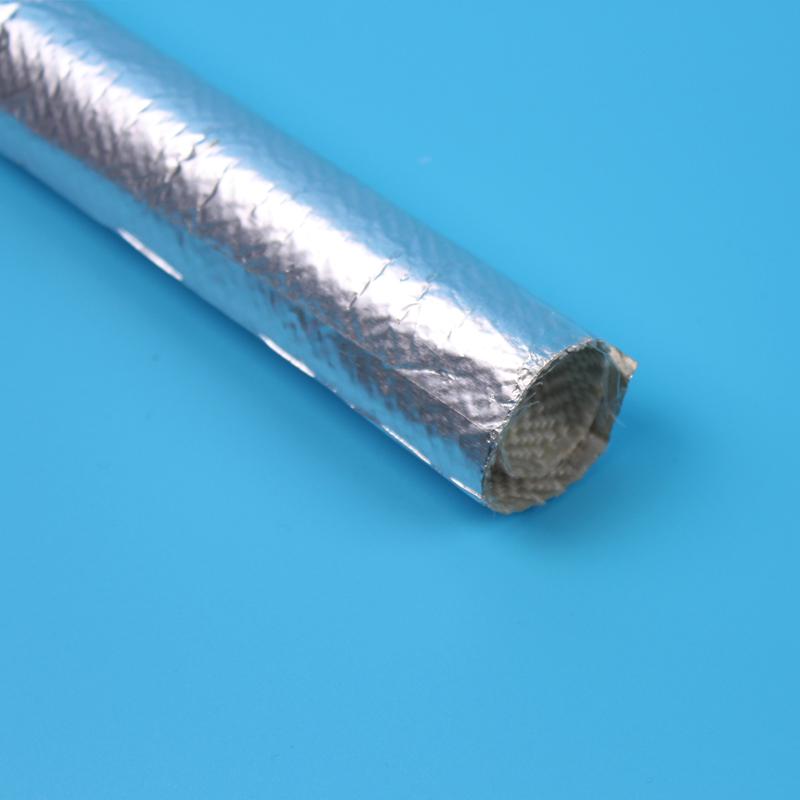
Let us dissect the physical structure thoroughly. We must examine fiberglass aluminum sleeving closely. The architecture relies entirely on two integrated functional layers. First, we explore the outer reflective layer. Manufacturers use a highly specialized metallic aluminum coating. This metallic skin acts as a dedicated thermal mirror. It physically bounces infrared radiation away safely. Radiant heat reflection metrics prove highly impressive in laboratory tests. This surface typically reflects up to 95% of incoming radiation. You must understand continuous exposure limits though. The adhesive bonding interface usually withstands 200°C to 260°C continuously. Radiant reflection easily handles much higher momentary thermal spikes.
Next, we look at the internal insulating core. Factories utilize tightly braided or knitted heat-resistant glass sleeving. This fiberglass base delivers a crucial secondary thermal break. It blocks any residual warmth crossing the metallic threshold. It also provides essential structural integrity for the entire assembly. The strong core prevents the tube from collapsing inward.
Finally, we evaluate manufacturing adhesion techniques. Factories bond the foil directly to the fiberglass base. They use specialized high-temperature thermosetting adhesives. The fundamental bond quality dictates the overall material lifespan. Poor adhesion leads to premature failure during continuous machinery vibration. The foil simply peels away from the base layer. You must specify high-quality bonding for active dynamic environments.
Engineers must evaluate protective materials using extremely strict criteria. Let us review temperature ratings thoroughly first. You must not confuse radiant reflection capacity. It differs completely from internal continuous ambient limits. Transparent industry-standard ratings place continuous limits around 200°C. Peak radiant spikes can temporarily exceed 500°C safely.
Sizing forms another critical evaluation dimension. You need the exact right internal diameter (ID). Follow a proven rule of thumb for accurate sizing. When specifying an industrial aluminum foil sleeve, leave a 10% to 15% physical allowance. This extra empty space accommodates internal cable movement smoothly. It also respects physical bend radius constraints. Furthermore, this internal air gap aids heat dissipation greatly.
Common Mistake: Engineers often specify an exact match to the cable bundle size. This tight fit prevents thermal expansion. It also causes dangerous internal heat trapping.
Next, consider abrasion and mechanical wear resistance carefully. Aluminum foil possesses clear physical limitations here. It does not survive high-friction environments very well. Constant mechanical rubbing aggressively tears the delicate metallic film. You might require a secondary protective layer outside. Sometimes a completely different robust material works better for friction zones.
Finally, assess overall chemical contaminant resistance. Think about exposure to industrial fluids, machinery oils, and harsh solvents. Prolonged chemical soaking degrades the vital adhesive layer. Keep the reflective sleeve away from pooling hydraulic fluids.
Procurement teams constantly compare competing materials. Let us contrast aluminum foil glass against silicone-coated fiberglass. Industry professionals often call the latter material "fire sleeve". Silicone handles molten metal splash exceptionally well. It easily survives direct flame exposure during welding. However, it feels significantly heavier. It also costs much more per foot. Aluminum performs superiorly for radiant heat reflection. It feels noticeably lighter on complex wire harnesses. Yet, it performs poorly against direct flames. It also fails quickly under heavy mechanical abrasion.
Now, let us compare bare braided fiberglass. Bare glass handles high continuous ambient heat effortlessly. It remains highly flexible around tight corners. However, it offers absolutely zero radiant reflection capability. Aluminum glass adds this critical radiant barrier. You only sacrifice a minor amount of physical flexibility.
We can summarize this shortlisting logic clearly. Look at this rapid decision matrix. It balances heat type against physical stress variables.
| Material Type | Primary Thermal Strength | Physical Weakness | Ideal Use Case |
|---|---|---|---|
| Aluminum Foil Glass | Radiant heat reflection (95%) | Poor heavy abrasion resistance | Proximity routing near heat sources |
| Silicone Fire Sleeve | Molten splash deflection | Heavier weight and higher expense | Direct flame or welding zones |
| Bare Braided Glass | Continuous ambient heat handling | Zero radiant reflection capability | Internal hot zones requiring flexibility |
Buying the correct material solves only half your problem. Proper physical implementation ensures long-term operational success. Let us explore different practical installation methods. Seamless tubular sleeving offers excellent continuous protection. It provides an unbroken barrier against intense thermal energy. However, you must disconnect active cables to install it. Wrap-around or split options provide a very different benefit. They allow rapid retrofitting on active assembly lines. You save massive labor time during routine maintenance.
Next, you must understand the serious delamination risk. Delamination remains the most common field failure mode. The metallic foil separates from the fiberglass base completely. Why does this separation actually happen? Improper field cutting acts as a major culprit. Excessive sharp bending also breaks the chemical bond. Prolonged soaking in harsh chemicals destroys the adhesive entirely.
You can actively avoid this failure. Follow strict end-sealing best practices perfectly. Good engineering demands properly secured sleeve ends. You prevent structural fraying. You also block hidden moisture ingress.
Best Practices for Installation:
These physical methods guarantee a durable, long-lasting industrial installation.
We thoroughly reviewed the extreme thermal threats facing industrial cables. You learned exactly why radiant heat requires highly specific shielding. Aluminum-coated glass solutions deliver a uniquely efficient protective barrier. They reflect intense infrared energy away extremely reliably. They also provide vital secondary insulation for underlying wires. This dual-action approach prevents catastrophic electrical equipment failures.
Procurement teams should take immediate, decisive action today. First, request detailed technical data sheets (TDS) from prospective suppliers. Second, strictly verify independent third-party flammability testing results. Finally, order small sample lengths for localized environmental testing. Test them thoroughly in your actual facility before executing a bulk deployment. These proactive steps ensure you choose the absolute best thermal protection.
A: The outer foil layer reflects up to 95% of radiant energy. It easily handles momentary radiant reflection spikes exceeding 500°C. However, you must monitor internal continuous operating temperatures closely. The underlying adhesive and fiberglass base typically max out around 200°C to 260°C. Never confuse momentary radiant spikes with continuous ambient temperature limits.
A: Yes, you can cut it cleanly. We highly recommend using specialized hot knives or heavy-duty industrial shears. A hot knife slightly fuses the inner fiberglass. After cutting, you must treat the exposed ends immediately. Wrap them firmly using high-temperature silicone tape. This completely prevents future mechanical fraying.
A: The material presents a unique dual electrical profile. The inner glass core remains an excellent electrical insulator. However, the outer aluminum layer is highly conductive. You must use extreme caution during installation. Carefully route the metallic exterior away from exposed electrical terminals. This safely prevents accidental short circuits.
A: The aluminum layer provides minimal electromagnetic interference shielding. It reflects some high-frequency external noise. However, manufacturers specifically design this sleeve for thermal management. It lacks the dense conductive braiding required for true EMI/RFI protection. You should specify specialized tinned copper sleeves if electrical shielding is your primary goal.