- All
- Product Name
- Product Keyword
- Product Model
- Product Summary
- Product Description
- Multi Field Search
Views: 0 Author: Site Editor Publish Time: 2026-07-11 Origin: Site
Unplanned downtime in industrial environments frequently traces back to compromised wiring. Selecting the right physical layer of protection remains a critical procurement and engineering decision. Industrial facilities face harsh conditions ranging from extreme thermal shifts to aggressive chemical exposure. When engineers specify the wrong cable protection, catastrophic system failures and immediate safety hazards occur. You need an objective, compliance-focused framework to evaluate these routing solutions effectively. This article guides facility managers and electrical specifiers through critical material selection and structural designs. We explore how to map measurable specifications against your specific environmental threats. You will learn to navigate essential compliance standards and apply proven field practices for safe installation.
You must frame your purchasing decision around specific environmental threats. Every facility features a unique combination of risks. The conduit must mitigate these hazards reliably over years of continuous operation. Failing to define these threats early leads to premature degradation.
Mechanical Stress & Crush Resistance: Evaluate dynamic versus static loads carefully. You must identify areas experiencing high foot traffic or frequent forklift operations. Robotic arms present another major challenge entirely. They require continuous, high-speed flexing. Without adequate crush resistance, internal wiring suffers catastrophic pinch damage. Assess specific load weights and movement cycle frequencies. This data determines your required mechanical impact strength.
Chemical & Corrosive Exposure: Map out the presence of ambient chemicals on the factory floor. This evaluation includes cutting oils, coolants, and harsh cleaning acids. Outdoor routing introduces ultraviolet (UV) radiation risks. These elements aggressively degrade unprotected plastics. They strip away structural integrity over time, leaving wiring vulnerable. A thorough chemical audit dictates the appropriate polymer grade for your industrial conduit pipe.
Thermal Extremes: Define your peak operating temperatures accurately. Industrial plants often experience rapid thermal cycling near furnaces or cold storage rooms. Ambient heat accelerates plasticizer migration in certain materials. Conversely, frozen environments cause severe material brittleness. Evaluate how extreme temperatures affect dynamic flexibility. Your system must survive these thermal swings without cracking or melting.
Transparent, side-by-side evaluations of common non-metallic materials help buyers match specifications to their exact environments. Choosing proper durable corrugated tubing requires precise material knowledge to avoid early replacements.
Best for: High continuous flexing, robotic applications, and extreme temperatures.
Nylon stands out in highly dynamic environments. It offers exceptional fatigue life under mechanical strain. Robotic dress packs rely heavily on Polyamide due to its incredible resilience. It withstands millions of bending cycles.
Trade-offs: Buyers face higher upfront costs. PA6 absorbs moisture in highly humid environments. This moisture absorption slightly alters its mechanical dimensions. We strongly recommend PA12 for outdoor or wet flexing. PA12 resists moisture ingress far better while retaining essential flexibility.
Best for: General-purpose facility wiring, excellent moisture resistance, and cost-effective scaling.
PVC dominates standard commercial and light-industrial installations. It repels moisture effectively and resists common mild chemicals. You can scale extensive wiring layouts economically using PVC compounds.
Trade-offs: PVC struggles significantly in extreme cold. It becomes highly brittle in sub-zero temperatures, risking immediate fracture upon impact. It is not ideal for continuous dynamic movement. Repeated bending causes stress fractures across the corrugated ridges.
Best for: Chemical resistance against strong acids or alkalis, and underground routing.
These materials provide superior defense against highly caustic agents. High-Density Polyethylene (HDPE) excels specifically in direct burial applications. It handles soil movement and ground moisture effortlessly.
Trade-offs: PE offers lower inherent crush resistance compared to heavy-duty Nylon. You must specify heavily reinforced variants if you anticipate significant mechanical loads or heavy machinery traffic overhead.
| Material Type | Dynamic Flexibility | Chemical Resistance | Thermal Range | Ideal Environment |
|---|---|---|---|---|
| Polyamide (PA6) | Excellent | Moderate to High | -40°C to +120°C | Robotics, indoor automation |
| Polyamide (PA12) | Excellent | High | -50°C to +95°C | Outdoor flexing, UV exposure |
| PVC | Low | Moderate | -20°C to +80°C | Static indoor facility wiring |
| HDPE / PE | Moderate | Very High | -40°C to +85°C | Direct burial, acidic zones |
Buyers must navigate structural design choices carefully during the planning phase. You balance installation speed against stringent environmental sealing requirements.
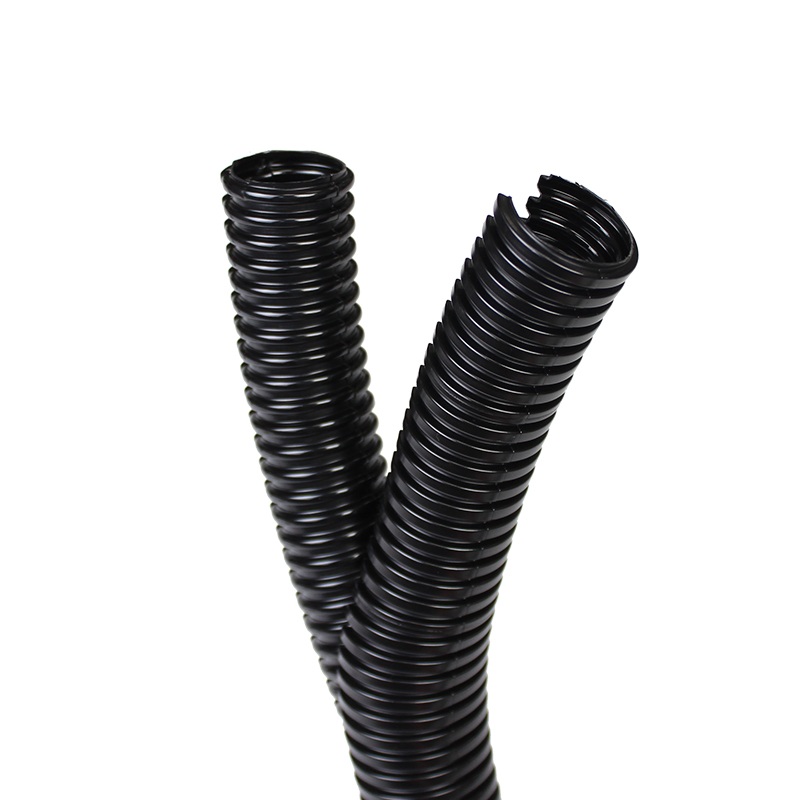
The Value: Retrofitting tasks demand exceptional speed. Maintenance overhauls require minimal operational disruptions. Installing split corrugated pipe allows technicians to repair existing wire looms easily. You do not need to disconnect the entire electrical circuit or remove heavy connectors. This structural design minimizes facility downtime during critical system upgrades.
The Reality Check: Recognize the severe drop in Ingress Protection (IP). Split pipe generally maxes out at IP40 or IP54. Moisture and fine dust can penetrate the longitudinal seam. You should never use split variants in washdown areas. They fail immediately in submerged applications or highly pressurized cleaning zones.
The Value: Original Equipment Manufacturer (OEM) builds necessitate absolute physical integrity. High-moisture environments demand seamless protection walls. Hazardous locations require continuous isolation to prevent gas or vapor ignition.
The Reality Check: When you pair it with properly sealed fittings, this conduit achieves IP67 or IP68+ ratings. It blocks micro-dust and high-pressure water effectively. However, installation takes longer. Technicians must measure lengths precisely before cable termination. You cannot slip it over pre-terminated cables easily during aftermarket modifications.
Authoritative trust requires grounding your evaluation in recognized industry standards. Selecting a non-compliant corrugated conduit pipe invites regulatory fines and safety shutdowns.
Interpreting IP Ratings: Understand the difference between dust-tight and liquid-tight enclosures. IP6X denotes complete protection against dust ingress. IPX7 indicates defense against temporary immersion. IPX8 signifies protection during continuous submersion. Practical industrial terms matter here. A food-grade washdown zone requires at least IP67. A dry robotic welding cell might only need IP54.
NEC & UL Alignment: Ensure your selected materials comply with the National Electrical Code (NEC). Specifically, review Article 356 and Article 362 for non-metallic routing applications. You must verify UL 1660 or UL 2239 listings. These certifications prove the material passed rigorous third-party testing. Unlisted products often fail municipal safety audits, forcing costly tear-downs.
Fire & Flammability: Self-extinguishing properties prevent localized electrical fires from spreading across the facility. Look for UL94 V-0 or V-2 flammability ratings. Enclosed spaces dictate stricter safety rules. Mass transit applications demand halogen-free materials. Halogenated plastics release toxic, corrosive gases when burned. Halogen-free solutions protect both personnel and sensitive server electronics during sudden fire events.
Field-level expertise prevents costly deployment errors on the factory floor. Proper handling of flexible corrugated conduit requires disciplined installation techniques.
Managing Bend Radius: Always respect minimum bend radius limitations. Every manufacturer specifies a dynamic and static radius. Over-bending causes immediate material stress. It stretches the outer wall while simultaneously crimping the inner wall. This distortion compromises the IP rating at the fitting interface. Severe bends also make subsequent wire pulling virtually impossible.
Fittings and Glands Dependency: The conduit remains only as strong as its terminations. A heavy-duty jacket fails quickly if paired with weak connectors. You must match thread types precisely. Common variants include NPT, Metric, and PG threads. Cross-threading ruins the environmental seal immediately. Always use manufacturer-approved locking fittings. They prevent pull-out during dynamic motion and heavy vibrations.
Thermal Expansion Allowances: Leave adequate slack in long conduit runs. Plastics expand and contract significantly during ambient temperature fluctuations. A rigidly constrained pipe will buckle under severe heat. It will snap under extreme cold. Employ sliding support brackets instead of rigid clamps for extended linear runs. This practice allows the material to float safely along its axis.
Choosing the correct protection layer represents a calculated engineering balance. You must weigh specific material properties against structural designs carefully. You must evaluate split versus continuous solid walls based purely on real environmental threats. By understanding the vulnerabilities of PVC, PE, and Nylon, you prevent catastrophic wiring failures.
Take these actionable steps to ensure facility safety:
A: Yes, provided the material is specifically UV-stabilized (typically carbon-black infused Nylon or specially treated PVC) to prevent UV degradation and brittleness.
A: Non-metallic corrugated conduit is significantly lighter, immune to rust, and offers superior flexibility for dynamic applications (like robotics), though LFMC may still be required for extreme physical crush risks or specific hazardous location codes.
A: Adhere to NEC fill ratios (typically 40% for multiple conductors) to ensure adequate heat dissipation and to prevent physical damage during wire pulling. Always refer to the inner diameter (ID), not the outer diameter (OD).