- All
- Product Name
- Product Keyword
- Product Model
- Product Summary
- Product Description
- Multi Field Search
Views: 0 Author: Site Editor Publish Time: 2026-11-10 Origin: Site
Routine cable maintenance often hits a wall when you deal with continuous tubular sleeving or rigid metal conduits. If you need to repair a single wire or retrofit a harness in an industrial plant or automotive bay, standard tubing forces you to disconnect hardware. You have to de-terminate cables, unpin connectors, and pull everything apart. This wastes labor hours, adds unnecessary weight, and causes unacceptable operational delays.
Modern infrastructure requires a smarter approach. split braided sleeving offers a retrofit-friendly alternative that balances mechanical durability with immediate maintenance accessibility. You can install it laterally over active harnesses without severing vital connections. This keeps critical machinery online. Technicians can protect, organize, and repair complex wiring systems on the fly, cutting down maintenance bottlenecks and improving overall system reliability.
Labor Efficiency: Split designs allow for lateral installation, eliminating the need to disconnect existing wire harnesses and reducing maintenance labor time by up to 40% compared to traditional conduits.
Material Durability: Industrial-grade PET braided cable sleeve constructions provide superior resistance to abrasion, sharp edges, chemical exposure, and thermal stress without trapping heat.
Risk Mitigation: Self wrapping braided sleeving maintains a consistent overlap (typically 25%), ensuring continuous wire protection even in dynamic, high-flex applications.
System Organization & Weight Reduction: Braided sleeves group multiple wires efficiently, improving system aesthetics and identification while offering significant weight savings over metal or heavy rubber alternatives.
Strategic Sourcing: Partnering with a qualified custom cable sleeving supplier is critical for securing specialized compliance ratings and configurations, such as double layer warning cable sleeve designs.
Installing standard non-split sleeving requires complete access to bare wire ends. You have to disconnect connectors, remove pins, and dismantle mounting hardware. This de-termination process introduces severe operational risks. Every time you unpin a Deutsch or Amphenol connector, you risk bending the pins or breaking the fragile internal locking tangs. Weather seals degrade upon reassembly. The time spent mapping pinouts, removing hardware, sliding on the continuous tube, and re-pinning the connector adds up fast. In a busy production facility, this translates to hours of system downtime just for a simple chafe-protection upgrade.
Solid corrugated wire loom tubing and metal conduits present their own severe limitations. Metal conduits are exceptionally rigid. They resist complex routing paths and require specialized bending tools. This rigidity transfers mechanical stress directly to the cable connectors during heavy vibration. Solid tubing also traps heat. High-current power cables generate thermal energy that cannot escape through solid plastic or metal walls. This accelerates insulation degradation. In weight-sensitive applications like aerospace or performance automotive systems, the bulk and mass of metal conduits add unnecessary weight penalties that directly impact fuel efficiency and payload capacity.
Consider a heavy machinery manufacturing floor. When a sensor wire gets pinched in a hydraulic press, maintenance teams cannot afford to shut down the entire line to thread a new solid conduit over the repaired wire. They need a solution they can wrap around the repair instantly. Traditional solid tubing fails this basic field requirement, forcing technicians into awkward, time-consuming workarounds.
Decision-makers must establish strict baseline requirements for modern cable protection. The primary success criterion is lateral installation. The chosen solution must wrap around existing, active wire harnesses. This capability minimizes downtime by completely eliminating the need to disconnect hardware. Technicians apply the protection exactly where it is needed, without taking the system offline.
Secondary criteria focus on structural integrity and independent closure. The sleeving must maintain its flexibility and protective matrix without relying on secondary fasteners. We look for these specific performance indicators in the field:
Independent shape retention without requiring zip ties every three inches.
Ability to accommodate complex harness architectures and sharp routing angles.
Easy breakout of individual cables at any point along the run.
Clean grouping of the main wire trunk to prevent snagging.
Wrapping an entire harness in electrical tape defeats the purpose of a clean, accessible system. The ideal retrofit solution holds its own shape while allowing technicians to branch wires out to sensors or relays seamlessly. It must provide a physical barrier against abrasion while remaining flexible enough to route through tight chassis bulkheads.
Engineers rely on the memory-spring action of self wrapping braided sleeving for fast installations. Manufacturers heat-set the braided monofilaments during production. This process gives the sleeve a natural tendency to curl back onto itself. When you open the split to insert a wire bundle, the sleeve immediately snaps shut once released. This creates a low-profile, continuous protective layer. The self-wrapping mechanism maintains a clean aesthetic while allowing instant access for future wire additions or inspections.
Hook-and-loop split sleeving offers an alternative closure method. It provides high security for massive, heavy wire bundles that might force a standard self-wrapping sleeve open. However, this security comes with distinct trade-offs. The hook-and-loop strip adds significant bulk to the harness. It creates a rigid spine that drastically reduces the overall bend radius of the cable assembly. In industrial settings, the hook-and-loop material acts as a magnet for dust, metal shavings, and chemical debris. Over time, the hook-and-loop fasteners lose their grip and fail.
The lightweight nature of braided cable sleeving vastly outperforms heavier alternatives in specialized fields. Aerospace, automotive, and robotics applications demand high flexibility and low mass. A self-wrapping braided matrix moves fluidly with robotic arms. It adds negligible weight to aircraft wiring looms and navigates the tight contours of an engine bay without kinking.
Sleeving Technology | Closure Mechanism | Flexibility / Bend Radius | Primary Drawback |
|---|---|---|---|
Self-Wrapping Braided | Heat-set memory spring overlap | Excellent (moves with cables) | Can open if overfilled past capacity |
Hook-and-Loop Braided | Stitched hook-and-loop strip | Moderate (stiff spine limits bends) | Attracts debris; adds bulk to harness |
Continuous Tubular | None (solid tube) | High (but requires stretching) | Requires complete connector de-termination |
Polyethylene Terephthalate (PET) is the standard material for wire protection. A PET braided cable sleeve delivers exceptional tensile strength while remaining highly flexible. The material easily withstands a broad operating temperature range, functioning flawlessly from -50°C up to 150°C. This thermal stability makes it suitable for freezing outdoor environments and hot industrial machinery enclosures alike.
PET inherently resists environmental degradation. It blocks UV radiation, preventing the underlying wire insulation from becoming brittle during prolonged outdoor exposure. The non-absorbent monofilaments repel moisture, preventing rot and fungal growth. PET also withstands exposure to common industrial fluids. It remains structurally sound when subjected to lubricating oils, cleaning solvents, hydraulic fluids, and automotive fuels. For example, in aviation maintenance, PET sleeving holds up against aggressive hydraulic fluids like Skydrol without melting or degrading.
Extreme environments sometimes exceed the capabilities of standard PET. In these scenarios, technicians utilize alternative high-performance materials. Polyphenylene Sulfide (PPS) offers superior chemical resistance and higher temperature thresholds. Nomex provides exceptional flame resistance for aerospace applications. Fiberglass braided sleeves handle extreme radiant heat, often protecting hoses and cables near exhaust manifolds or blast furnaces.
The open-weave structure of braided sleeving directly maps to critical mechanical outcomes. The tough monofilaments provide superior abrasion resistance against constant rubbing. When cables route through sheet metal chassis or sharp bulkheads, the braided matrix acts as a sacrificial barrier. It absorbs the friction that would otherwise slice through soft silicone or PVC wire insulation. The woven design also disperses localized impact forces, protecting delicate internal conductors from crushing damage.
Thermal management represents a massive advantage over solid conduits. The breathable matrix prevents moisture accumulation by allowing condensation to evaporate instantly. More importantly, it prevents thermal entrapment. High-current power cables generate heat under load. A braided sleeve allows this thermal energy to dissipate naturally into the surrounding air. This cooling effect preserves the integrity of the wire insulation and prevents dangerous overheating conditions. Battery cables in heavy equipment rely heavily on this breathability to prevent thermal runaway.
Dynamic environments punish rigid materials. Automated machinery, CNC drag chains, and robotic joints require constant, repetitive movement. Rigid conduits suffer from material fatigue and eventually crack under these conditions. The braided matrix flexes, expands, and contracts dynamically. It moves in harmony with the wire bundle, ensuring long-term mechanical survival without restricting the machine's range of motion.
Braided sleeving instantly transforms chaotic wiring into organized, manageable systems. It tightly groups multiple independent wires into a single, cohesive trunk. This consolidation drastically reduces visual clutter inside control panels and server racks. By binding loose wires together, the sleeving eliminates dangerous snagging hazards. Technicians can safely reach into dense equipment bays without accidentally catching and ripping out a loose sensor wire.
Visual identification streamlines maintenance workflows. Facilities utilize color-coded sleeving to map complex systems instantly. A technician can identify a high-voltage power line wrapped in orange sleeving from across the room. Blue sleeving might designate data lines, while red indicates critical safety circuits. This rapid system identification reduces troubleshooting time and prevents catastrophic errors during emergency repairs. In large-scale server farms, color-coded braided sleeves allow network engineers to trace miles of CAT6 cables without relying solely on tiny printed labels.
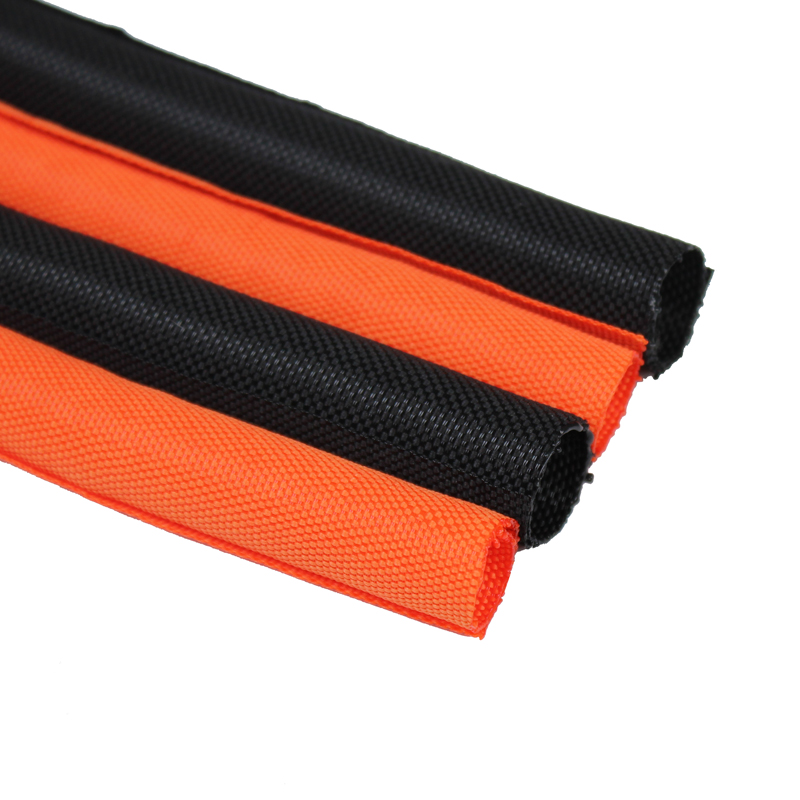
High-risk environments demand proactive safety measures. The implementation of a double layer warning cable sleeve provides immediate visual feedback regarding mechanical wear. These sleeves utilize contrasting colors for the internal and external layers. For example, a black exterior might hide a bright red interior. If heavy abrasion wears through the black outer layer, the red interior instantly becomes visible. This acts as an early warning system, allowing maintenance teams to replace the sleeve before the actual wire insulation sustains damage.
Regulatory compliance dictates material selection in specialized industries. Aerospace, rail transport, and enclosed marine spaces require strict adherence to safety standards. Technicians must specify flame-retardant (FR) variants that self-extinguish when a heat source is removed. Halogen-free materials are mandatory in confined spaces to prevent the release of toxic gases during a fire. Verifying UL/CSA certifications ensures the sleeving meets the rigorous safety demands of modern industrial infrastructure.
Evaluating cable protection requires looking beyond the initial purchase order. A primary trade-off exists: split braided sleeving generally carries a higher upfront per-foot material cost compared to basic corrugated split loom. Procurement teams might initially hesitate at this premium. However, evaluating the true operational efficiency reveals a different reality. The material cost represents only a fraction of the total installation expense.
The real value emerges through drastic reductions in installation time and future maintenance labor. Because the split design allows lateral installation over active harnesses, facilities avoid expensive system shutdowns. You eliminate the labor hours previously spent de-pinning connectors and re-routing wires. Furthermore, the weight reduction provided by lightweight braided matrices translates directly into fuel savings for transit and aerospace applications. For complex harnesses where downtime is highly penalized, these operational labor savings heavily outweigh the initial material premium.
Securing high-quality materials requires partnering with a reliable custom cable sleeving supplier. Supplier selection should focus on strict quality control metrics. Look for ISO certifications that guarantee consistent manufacturing processes. Lot traceability is essential for aerospace and automotive sectors, ensuring any material defects can be tracked back to the source batch. Suppliers who offer custom cut-to-length services significantly reduce your in-house preparation labor.
Documentation proves compliance. Before committing to bulk procurement, always request Technical Data Sheets (TDS) and Material Safety Data Sheets (MSDS). The TDS verifies the mechanical properties, temperature ratings, and chemical resistance of the specific sleeve. The MSDS ensures environmental and safety compliance, confirming the material is safe for your technicians to handle and install in confined spaces.
Improper sizing compromises the entire protective system. If the wire bundle diameter exceeds the sleeve's maximum capacity, the split will pull apart. This exposes the internal wires to abrasion and allows the bundle to break out of the sleeve, especially around tight bends. A sleeve that remains open acts as a dirt trap and fails to provide structural support.
Mitigating this risk requires precise measurement. Always calculate the maximum bundle diameter at its thickest point, including any internal splices or junctions. Select a sleeve size that guarantees a minimum 25% overlap of the split edges when fully populated. This overlap ensures the sleeve remains securely closed even when flexed at sharp angles or subjected to heavy vibration.
Nominal Sleeve Size | Recommended Max Bundle Diameter | Overlap Percentage Achieved |
|---|---|---|
1/4 Inch (6.4mm) | 3/16 Inch (4.8mm) | ~25% - 30% |
1/2 Inch (12.7mm) | 3/8 Inch (9.5mm) | ~25% - 30% |
1 Inch (25.4mm) | 3/4 Inch (19.1mm) | ~25% - 30% |
Braided monofilament materials inherently fray when cut with standard scissors or wire cutters. The woven strands unravel rapidly, creating a messy installation that degrades over time. Unraveling ends can catch on moving machinery or block connector housings.
The mandatory implementation practice is using a hot-knife cutter. A hot knife slices through the PET material while simultaneously melting the monofilaments together. This creates a clean, fused edge that will never fray. When field repairs require cutting and hot knives are unavailable, technicians must adapt. Mitigation strategies include using specialized fray-resistant split sleeving designed for cold-cutting, or applying temporary heat-shrink end caps to secure the raw edges until proper termination is possible.
Split braided sleeving is a technically sound choice for environments demanding frequent maintenance and upgrades. It delivers robust retrofit protection without sacrificing mechanical durability, system aesthetics, or weight efficiency. The ability to install protection laterally eliminates the severe downtime associated with traditional conduits. Base your final material selection on precise bundle diameter calculations, required overlap percentages, and specific environmental exposures like UV, chemicals, or sharp edges. Ensure all selections meet your industry's specific compliance standards.
To optimize your cable management strategy, take these immediate actions:
Conduct a thorough audit of your current maintenance bottlenecks to identify where connector de-termination causes the most downtime.
Calculate the potential labor hours saved by switching to lateral-installation split sleeving for your next major retrofit project.
Measure the maximum diameter of your most complex wire bundles to determine the exact sizing needed for a 25% closure overlap.
Contact a specialized supplier to request material samples, TDS documentation, and compliance certificates for technical evaluation.
A: Standard wire loom is often a solid, continuous tube requiring you to disconnect cables for installation. Split braided sleeving features a lateral slit, allowing you to wrap it around existing, active wires without removing connectors. Braided sleeving is also highly flexible, breathable, and lighter than solid corrugated loom.
A: You must use a hot-knife cutter. The heated blade melts the PET monofilaments as it cuts, fusing the ends together to create a clean, sealed edge. If a hot knife is unavailable in the field, you can use specialized fray-resistant sleeving or temporarily secure the ends with heat-shrink tubing.
A: Standard PET sleeving operates safely up to 150°C, which is suitable for many industrial applications. However, for extreme high-temperature environments like engine bays or near exhaust systems, you should upgrade to specialized materials like fiberglass or Nomex, which withstand significantly higher radiant heat.
A: It acts as an early visual warning system for mechanical wear. The sleeve features contrasting colors for the inner and outer layers. If abrasion wears away the outer layer, the bright internal color becomes visible, alerting technicians to replace the sleeve before the underlying wires are damaged.
A: Measure the maximum diameter of your wire bundle at its thickest point. Choose a sleeve size that is slightly larger than this diameter to ensure the split edges overlap by at least 25%. This overlap guarantees the sleeve remains securely closed, even when routed around tight corners.
A: No. High-quality self-wrapping braided sleeving utilizes a heat-set memory spring action. It naturally curls back onto itself and maintains a secure overlap without the need for secondary fasteners like zip ties or electrical tape, keeping the installation clean and easily accessible.