- All
- Product Name
- Product Keyword
- Product Model
- Product Summary
- Product Description
- Multi Field Search
Views: 0 Author: Site Editor Publish Time: 2026-09-23 Origin: Site
Selecting the wrong cable management material leads to premature wire harness failure, electrical shorts, and system downtime in demanding environments. Engineers and procurement teams frequently encounter overlapping specifications when evaluating protective sleeving. A common misconception assumes PET and nylon are interchangeable. Some even think they are the exact same material. This confusion leads to over-speccing, which wastes project resources, or under-speccing, which risks catastrophic mechanical failure. Understanding the exact differences between these polymers ensures accurate material specification. This guide provides an objective, side-by-side technical evaluation of PET vs nylon braided sleeving. We analyze their polymer characteristics, environmental tolerances, and mechanical limits. You will learn how to match the right polymer to your specific routing environment to guarantee long-term harness survival.
Material Distinction: PET (Polyethylene Terephthalate) and Nylon (Polyamide) are distinct polymers; PET excels in moisture and chemical resistance, while Nylon offers superior mechanical toughness and abrasion resistance.
Environmental Tolerances: Nylon is the standard for high-friction, heavy-duty environments (e.g., automotive, heavy machinery), whereas PET is ideal for general-purpose wire routing, marine, and continuous-flex applications where fluid absorption is a concern.
Installation Dynamics: Both materials function as expandable braided sleeving, featuring lateral stretchability to adapt to different cable diameters, but their expansion ratios and memory retention differ, impacting installation speed and final harness diameter.
Procurement Strategy: Partnering with a specialized braided cable sleeve manufacturer is critical for securing custom diameters, specific thermal ratings, and precise hot-cut lengths that prevent installation fraying.
Polyethylene Terephthalate (PET) is a highly versatile thermoplastic polymer resin. It forms the foundation for many protective cable management solutions across multiple industries. Engineers rely on PET braided sleeving because it delivers high tensile strength alongside super flexibility. The extrusion process creates a smooth, slick monofilament that resists snagging. It features natural UV resistance and exceptional moisture resistance. The material possesses a relatively light specific gravity. This lightweight nature proves highly beneficial for weight-sensitive aerospace and automotive applications where every gram matters.
A common industry misconception assumes PET is just a generic term for nylon. This is entirely false. PET features a fundamentally different chemical structure. It behaves differently under mechanical stress and environmental exposure. It is synthesized through the polymerization of ethylene glycol and terephthalic acid. This creates a highly stable molecular structure that resists environmental degradation naturally. When you handle PET sleeving, it feels smooth and slides easily over wire bundles. The braiding process uses high-speed carriers that interweave the monofilaments into a tubular matrix. This matrix gives PET its signature lateral expandability. The slick surface of the PET monofilaments reduces internal friction between the sleeving and the wire insulation, preventing chafing on the primary wire insulation during installation.
Nylon typically refers to Polyamide 6 or Polyamide 6.6 in the manufacturing sector. It is a synthetic polymer renowned for its raw structural integrity. Engineers specify nylon braided sleeving when physical durability is non-negotiable. It boasts exceptional abrasion resistance and a high deflection temperature. The dense monofilament structure withstands severe physical abuse effortlessly. The amide links in its polymer chain provide immense intermolecular forces. This translates to unmatched physical toughness.
However, nylon comes with a primary trade-off. The material is inherently hygroscopic. It absorbs moisture from its surrounding environment. This absorption can slightly alter its physical properties in highly humid conditions. A wet nylon sleeve becomes slightly heavier and may experience minor changes in flexibility. The surface texture of nylon feels slightly rougher and more rigid than PET. When subjected to crush loads, nylon retains its tubular profile better than standard polyester. The monofilaments resist flattening, which protects the internal wires from blunt force impacts. Polyamide 6.6 variants offer even higher thermal stability, making them a staple in heavy-duty engine compartments. When routed through stamped metal bulkheads, nylon acts as a robust sacrificial barrier. It takes the brunt of the mechanical wear, preserving the delicate copper wires inside.
Wire harnesses in dynamic environments face continuous friction against chassis components. Moving parts constantly rub against cable bundles. Engine vibrations, robotic arm movements, and vehicle suspension travel cause relentless physical wear. PET offers moderate to high abrasion resistance. It works exceptionally well for static routing or low-vibration enclosures. While tougher than standard textile sleeving, it is not the maximum-durability option. Under heavy, continuous scraping, PET monofilaments will eventually wear thin and snap.
Nylon delivers superior abrasion resistance. It withstands significantly more friction cycles before any monofilament degradation occurs. The hardness of the polyamide monofilament resists cutting and scraping. Nylon acts as a sacrificial barrier that lasts exponentially longer than PET under identical friction loads. Nylon is mandatory for heavy industrial and automotive under-hood applications where mechanical wear remains the primary failure risk. Standard scrape abrasion tests reveal that nylon can endure thousands of additional cycles compared to PET before exposing the internal wires. This makes it the default specification for heavy equipment manufacturers.
Thermal tolerance directly impacts harness longevity and safety. Continuous exposure to high temperatures causes polymer embrittlement over time. PET features a typical continuous operating range of -50°C to 150°C. It handles the ambient heat of server rooms and standard electronic enclosures perfectly. Its melting point sits around 250°C. Nylon shares a similar continuous operating range of -45°C to 150°C. However, nylon maintains its mechanical toughness better at the upper limits of this temperature band. It does not soften as quickly as PET when exposed to sudden thermal spikes.
Both materials perform reliably in standard high-temperature environments. Specialized nylon variants often achieve higher peak thermal deflection ratings for extreme applications. In cold environments, both polymers resist cracking, but PET maintains slightly better flexibility at -50°C.
Technical Property | PET Braided Sleeving | Nylon Braided Sleeving |
|---|---|---|
Polymer Base | Polyethylene Terephthalate | Polyamide 6 / 6.6 |
Abrasion Resistance | Moderate to High | Extreme / Superior |
Moisture Absorption | Zero (Hydrophobic) | Low to Moderate (Hygroscopic) |
Typical Expansion Ratio | Up to 3:1 | 1.5:1 to 2:1 |
Continuous Operating Temp | -50°C to 150°C | -45°C to 150°C |
Acid Resistance | Excellent | Susceptible to strong acids |
Environmental exposure dictates material selection in outdoor and industrial settings. Automotive and industrial environments are filled with harsh fluids. Engine oil, hydraulic fluid, brake fluid, and coolants frequently coat wire harnesses. PET is highly resistant to automotive fluids, solvents, and UV degradation. More importantly, PET is completely hydrophobic. It boasts zero moisture absorption. If submerged or exposed to heavy rain, it retains its exact weight and flexibility. This hydrophobic nature keeps the sleeving stable in wet conditions.
Nylon also resists oils and standard solvents. However, nylon remains susceptible to strong acids. Because it absorbs moisture, nylon can experience slight swelling. Its flexibility may change over time in damp environments. PET stands as the superior choice for marine, outdoor, or fluid-heavy environments. It eliminates the risks associated with moisture ingress entirely.
Ease of installation over bulky connectors requires lateral stretchability. The braided construction allows the sleeving to expand laterally. When you push the ends of the sleeve together, the diameter increases. When you pull it taut, the diameter shrinks tightly around the cables. PET functions as a highly flexible expandable braided sleeving. It typically offers a massive 3:1 expansion ratio. A single sleeve can easily slide over large USB connectors, bulky sensor plugs, and thick splices. Once over the connector, it pulls tight over the thinner wire bundle.
Nylon monofilaments are inherently stiffer due to their density. The resulting weave resists lateral expansion more than PET. Nylon sleeves typically offer lower expansion ratios, often limited to 2:1 or 1.5:1. You must size nylon sleeves much more accurately prior to installation. The stiffer nature of nylon also means it has stronger memory retention. It wants to return to its original nominal diameter aggressively, which provides a very tight, secure fit once installed.
Selecting the right material prevents future system failures and reduces maintenance overhead. You should specify PET for general-purpose electronics and massive IT server racks. The high expansion ratio speeds up installation over complex network cables. PET excels in marine and aerospace applications. These sectors require low outgassing, a light specific gravity, and absolute moisture resistance. Marine engine bays, outdoor telecommunications equipment, and offshore drilling rigs benefit heavily from its hydrophobic nature. PET is also perfect for applications requiring long, continuous flex cycles. It performs flawlessly in automated machinery as long as there is no heavy surface friction involved.
Marine navigation and radar wiring harnesses.
Aerospace control panel routing.
Server rack cable management and IT infrastructure.
Indoor automated assembly lines.
Custom PC building and consumer electronics.
Nylon thrives in brutal, high-impact environments. Specify nylon for demanding automotive wire harness braided sleeve applications. It protects cables routed through cramped engine bays and along rough chassis components. It survives the constant vibration against metal engine blocks. Nylon is the go-to material for heavy machinery, robotics, and manufacturing equipment. Industrial robotics use nylon on articulating arms where the sleeving drags across factory floors millions of times per year. Choose nylon for any environment where cables are dragged, pulled, or subjected to sharp edges. It offers unmatched protection when physical survival is the only metric that matters.
Automotive under-hood wiring and chassis routing.
Heavy construction equipment harnesses.
Industrial robotic welding arms.
Mining and agricultural machinery.
High-vibration generator enclosures.
Sizing errors ruin cable assemblies and complicate installations. Over-sizing leads to loose sleeving that easily snags on nearby components. It fails to grip the wires securely. Under-sizing causes the sleeving to contract in length as it expands laterally. When braided sleeving stretches to its maximum lateral limit, it loses overall length rapidly. This leaves critical cables completely exposed at the ends of the harness. To solve this, you must follow a strict measurement protocol.
Measure the maximum outer diameter of the main cable bundle using digital calipers.
Measure the widest connector or splice that the sleeving must pass over during installation.
Select a nominal sleeve size that matches the main cable bundle diameter.
Verify that the sleeve's maximum expansion diameter exceeds the width of your largest connector.
Calculate the length shrinkage. If the sleeve expands significantly to cover the bundle, add 10% to 20% extra length to your cut to compensate for the contraction.
Improper cutting techniques destroy braided sleeving instantly. Braided sleeving is essentially a woven fabric made of plastic wire. Both PET and nylon monofilaments will fray if cut with standard cold steel scissors. The individual monofilaments separate, creating a messy, unmanageable brush at the ends. This fraying will travel down the length of the sleeve during installation, ruining its structural integrity. You must implement mandatory hot-knife cutting procedures. A hot knife heats a metal blade to over 500°C. As the blade slices through the sleeving, it melts the monofilaments. The heated plastic fuses together instantly. This creates a clean, permanent seal that prevents unravelling. The sealed end easily pushes over cables without snagging. Proper ventilation is required when hot-cutting to manage the fumes generated by melting polymers.
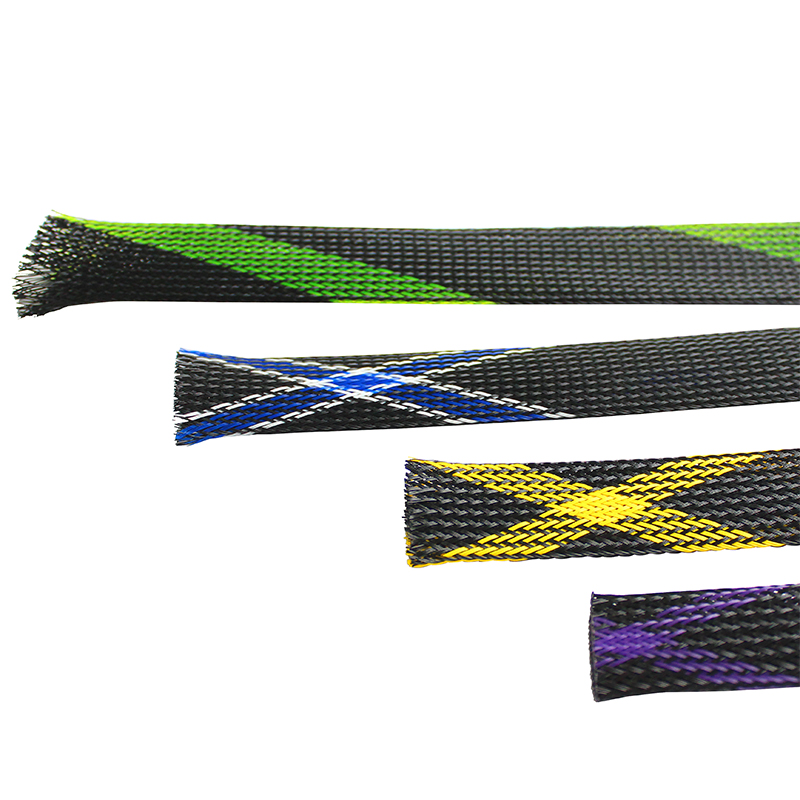
Off-the-shelf solutions do not always fit complex engineering requirements. There is immense value in working directly with a specialized braided cable sleeve manufacturer. Direct partnerships unlock access to standard and custom colors for precise circuit identification. You can order sleeving with custom color tracers woven directly into the braid. This allows technicians to identify specific circuits instantly without tracing wires manually. You can request pre-cut lengths to significantly reduce manual labor time on the assembly line. Manufacturers use automated hot-cutting machines to deliver thousands of perfectly sealed, identical sleeves.
Manufacturers can also provide a custom braided cable sleeve with specialized coatings. These include flame retardant treatments, tighter weave patterns for maximum coverage, or EMI shielding integrations for sensitive electronics. Specifying custom lengths and colors directly from the factory streamlines your assembly process and ensures consistent quality control across all production batches.
Audit your current wire harness failure rates to identify specific abrasion or moisture vulnerabilities in your routing paths.
Measure the maximum outer diameter of your connectors to calculate the exact expansion ratio required for your next build.
Request physical material samples to conduct in-house friction and thermal testing on your assembly line.
Implement mandatory hot-knife cutting procedures to eliminate monofilament fraying during installation.
A: No. PET (Polyethylene Terephthalate) is a polyester-based polymer, while nylon is a polyamide. They feature completely different chemical structures. They also have distinct abrasion ratings and moisture absorption properties. You cannot interchange them in high-stress mechanical environments without risking harness failure.
A: Nylon provides significantly higher abrasion resistance. Its tougher monofilament structure makes it the standard for automotive and heavy industrial applications. While PET is tougher than basic textile sleeving, it cannot match Nylon's extreme friction tolerance against metal chassis components.
A: Measure the thickest part of your cable bundle or connector. Choose a nominal sleeve size that matches or is slightly smaller than your bundle. Factor in the sleeve's specific expansion ratio, typically 2:1 or 3:1. A 1/4-inch cable bundle requires a 1/4-inch nominal sleeve for a tight fit.
A: It is highly discouraged. Cutting PET or nylon sleeving with cold scissors causes the monofilaments to fray instantly. This compromises the sleeve's structural integrity and makes installation difficult. Always use a hot knife to cut and seal the ends simultaneously.
A: Yes, nylon is hygroscopic. It absorbs small amounts of moisture from the surrounding environment. This absorption can slightly affect its flexibility and physical properties over time. If strict moisture resistance is required for your application, PET is the recommended alternative.
A: Yes. Most manufacturers offer both standard and custom color options. You can request specific color-coding, tracer lines, and custom-cut lengths. This ensures the sleeving matches your exact engineering specifications and simplifies troubleshooting during maintenance.